

Introduction
Home equity lending is having a moment. Homeowners are sitting on a near-record amount of untapped value, rates on home equity products have been trending down, and a huge share of borrowers are locked into low-rate first mortgages that make cash-out refinancing unattractive. All of that is pushing demand toward HELOCs and home equity loans.
But demand alone doesn’t win market share. Lenders capturing this opportunity aren’t just those with the best rates—they’re the teams that move fast. Home equity products have long suffered from fragmented, manual workflows that stretch closing timelines well past what today’s borrowers expect. Every day added to a cycle time is a day a borrower can walk to a competitor, or abandon the
loan altogether.
This ebook examines the home equity market in 2026, why speed has become the deciding factor in winning and closing this business, and how Lender Portal—a new capability within the FirstClose XpressEquity point of sale—is built to bridge that gap.
U.S. homeowners hold a near-record $34.5 trillion in home equity, roughly $302,000 per homeowner. —Source: MeridianLink, 2026
The State of Home Equity Lending in 2026
Home equity is no longer a niche corner of the lending business—it’s one of the largest untapped pools of consumer wealth in the country, and 2026 is shaping up to be a pivotal year for lenders who can access it efficiently.
Rate forecasts for the remainder of 2026 point to a largely flat environment—averaging around 7% for HELOCs and 8% for home equity loans—giving lenders a relatively stable window to plan around, rather than chasing a moving target.
Homeowners withdrew an estimated $47 billion in equity in Q1 2026 alone—the highest first-quarter total since 2021. —Source: ICE Mortgage Monitor, June 2026 (via FirstClose)
Why Borrowers Are Turning to Home Equity
Two forces drive borrowers toward home equity products instead of first-lien refinancing or unsecured debt:
The Lock-In Effect
More than 80% of existing mortgages carry rates below 6%. For millions of homeowners who refinanced into 3% rates in 2020–2022, a cash-out refinance today would mean giving up that rate entirely—often adding hundreds of dollars to their monthly payment just to access their own equity. Second-lien products let them tap that value without disturbing their primary mortgage.
How The Money Is Being Used
- 61% of borrowers use home equity products for renovations and property investment.
- 39% use funds for debt consolidation, emergency needs, and medical expenses.
- Both categories reward speed. A homeowner mid-renovation with contractors on hold, or a borrower trying to escape high-interest credit card debt, isn’t going to wait six weeks for funding. And if your process takes that long, your competitors’ process won’t.
The Hidden Complexity Lenders Face
If home equity lending is such a clear opportunity, why do so many lenders struggle to move quickly? The answer is structural, not just operational.
Home equity products don’t cleanly fit into any one lending department. HELOCs typically follow consumer lending conventions, while closed-end seconds fall under mortgage regulations. Most institutions end up inheriting complexity from both sides—without dedicated infrastructure built to handle either efficiently.
In practice, that means valuations, title work, flood certification, and closing coordination are often still managed manually, across scattered email threads and separate vendor portals, rather than through a single, centralized workflow.
That single data point is the crux of the problem—and the opportunity. Cycle time isn’t just a customer-experience metric; it’s directly tied to how much of your pipeline actually closes.
When cycle times compress from 40–45 days to under 10 days, pull-through improves and funded volume increases. —Source: FirstClose, Home Equity Lending in 2026
Speed Wins—The Business Case for Faster Cycle Times
Every extra day in a home equity closing timeline means:
- borrowers continue rate shopping
- a competitor has a faster process
- your borrower’s patience is running out
Lenders pulling ahead in 2026 share one trait: they’ve automated order management for valuations, title, flood, and closing coordination through a centralized workflow instead of managing each step manually.
The national average HELOC rate stood at 7.44% as of early August 2026, after falling from 9.99% in September 2024. —Source: Bankrate, August 2026
We’ve been able to shave about a week off our timeline. That’s a significant improvement in efficiency, especially for our underwriters and borrowers.”
Lauren Schumacher
Senior Consumer Loan Underwriter at Mascoma
Read the full story
What Faster Cycle Times Deliver
- Higher pull-through: fewer loans fall out between application and close.
- More funded volume from the same lead flow—you’re not generating more demand, you’re losing less of what you already have.
- A better borrower experience in a category where borrowers increasingly compare lenders online before applying.
- More capacity for loan officers and ops teams, since manual vendor coordination is often the single biggest time-sink in the process.
Technology stops being “nice-to-have” and becomes the deciding factor in whether a lender can compete for this volume.
Introducing Lender Portal, Powered by XpressEquity
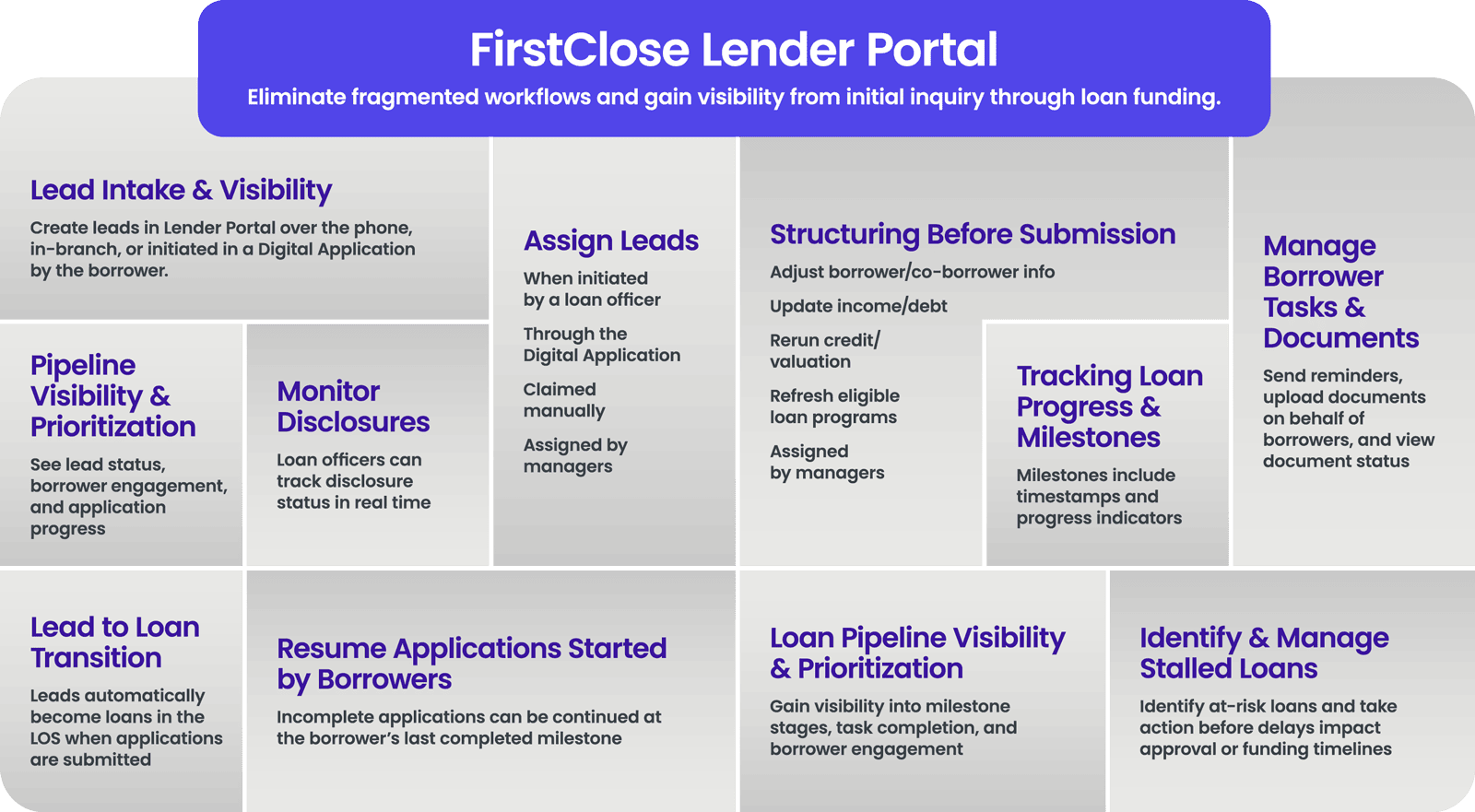
Lender Portal is a new capability within the FirstClose XpressEquity point of sale, built specifically to address the structural bottlenecks outlined in this ebook.
What It’s Built to Solve
- Centralizing valuation, title, flood, and closing coordination into a single workflow instead of scattered vendor portals and email threads.
- Give lenders real-time visibility into where every lead and loan file stands, reducing the manual status-checks that consume processing time.
- Compress cycle times from the industry-typical 40–45 days to under 10 days that top-performing lenders achieve.
- Bridge compliance requirements of HELOCs and closed-end seconds.
Conclusion & Next Steps
The opportunity in home equity lending in 2026 is real: record equity valuation, resilient demand, and rates that make these products more attractive than they’ve been in years. But lenders who capture this opportunity will be those that solve the speed problem—not just the pricing problem.
Lender Portal, within FirstClose XpressEquity point of sale, is built to help lenders close that gap: less manual coordination, faster cycle times, and more of your pipeline actually reaching the closing table.